

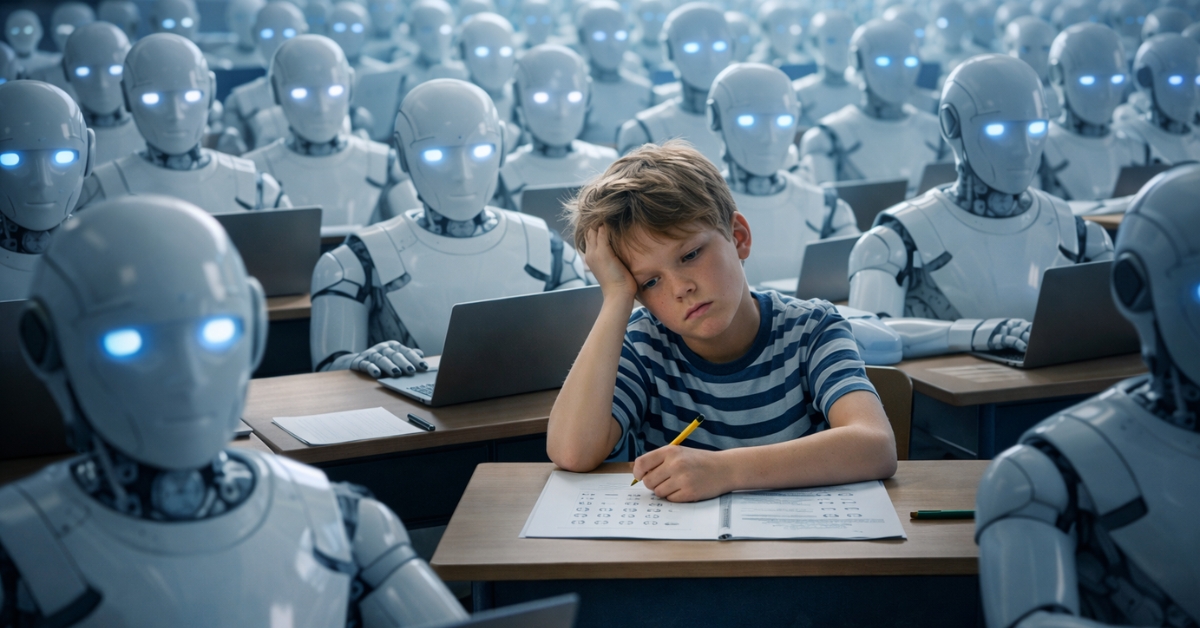
A bot called Einstein went viral recently. Not for what it promised, but for what it proved.
Einstein connects to Canvas, the learning platform used by millions of college students, and does everything for them. Watches lectures. Reads assignments. Writes papers. Takes quizzes. Submits the work. A journalist tested it on a free introductory statistics course. In less than an hour, the bot completed all eight modules and seven quizzes. Perfect score. The journalist never even read the course website.
Everyone is panicking about the wrong thing.
The conversation around AI in education has been the same since ChatGPT landed. Students are cheating. Critical thinking is dying. We need to ban the tools, detect the fraud, build better walls.
The walls are already gone. Students now blend outputs from different AI models and instruct them to roughen the grammar so it passes for human. Plagiarism detectors are losing a war they were never equipped to win. And now we have tools that don’t just write the essay. They complete the entire course without a human being involved.
But here is the part nobody wants to say out loud. If a bot can earn a perfect score in your class without understanding a single concept, the bot is not the problem. The class is.
A RAND survey of over 1,200 students found that AI use for homework jumped from 48 percent to 62 percent between May and December of 2025. In that same window, 67 percent of students said they believe AI is harming their critical thinking skills. Among middle schoolers, that concern rose from 48 to 68 percent in just seven months.
Read that again. Students are using AI more and more while simultaneously believing it is making them worse thinkers. They see the damage. They keep going. Because the system does not reward understanding. It rewards completion.
Turn it in. Get the grade. Move on.
So instead of asking how do we stop students from using AI, maybe we ask a better question. Why was the system so easy to automate in the first place?
Standardized tests. Rote memorization. Multiple choice. Five-paragraph essays with a thesis, three body paragraphs, and a conclusion that restates the thesis. We built an education system around outputs. AI is very good at outputs. We should not be surprised.
The real failure is not that students are outsourcing their thinking to machines. It is that we never made thinking the point.
Critical thinking is not a byproduct of education. It is the product. Or it should be.
Kids as young as five can learn to ask how do you know that and what is another explanation. You do not need formal logic. You need a habit of questioning. You need classrooms where the answer matters less than the reasoning. Where being wrong and revising is more valuable than being right the first time. Where the blank page and the first draft and the struggle are not obstacles to learning. They are the learning.
One researcher called it first-draft thinking. That moment of friction where you have to draw on what you actually know before anyone or anything helps you. AI skips that step entirely. And when you skip it long enough, the muscle atrophies.
Teach students to interrogate AI instead of banning it. Ask the bot a question, then find what it got wrong. Now you are teaching source evaluation, skepticism, and verification. The tool becomes the curriculum.
Shift assessment from answers to process. How did you get here. What did you consider and reject. Where are you least confident and why. These are questions a bot cannot fake.
Here is the uncomfortable truth. Teachers are using AI too. To design assignments, grade against rubrics, generate worksheets. Both sides of the classroom are outsourcing cognition. The whole ecosystem needs the reset.
We do not fix this by fighting the technology. We fix it by finally building what we should have built all along. A system that teaches people how to think. Early. Often. On purpose.
AI did not break education.
It just showed us the cracks were already there.